Wednesday, 16 November 2011


Wednesday, 9 November 2011
Brief for Opening Sequence
For our Coursework we have been assigned to make the opening scene of a film with titles!
The film is going to be a new fiction film and should last two minutes.
The video and audio have to be copyright free. For example; the video has to have been filmed yourself and the audio must have either been recorded with the camera or downloaded from a copyright free site.
We will be marked on
-holding a shot steady where appropriate
-framing shot, including and excluding elements where appropriate
-the variety of shots used e.g. distances etc.
-research and planning
-and level of care posting about it on our blogs.

The film is going to be a new fiction film and should last two minutes.
The video and audio have to be copyright free. For example; the video has to have been filmed yourself and the audio must have either been recorded with the camera or downloaded from a copyright free site.
We will be marked on
-holding a shot steady where appropriate
-framing shot, including and excluding elements where appropriate
-the variety of shots used e.g. distances etc.
-research and planning
-and level of care posting about it on our blogs.

Wallander Analysis
The establishing shot of the isolated place by the sea shows there is hardly any civilisation. It is shot from a helicopter, so you get a birds eye view of the quiet, peaceful hilltop setting. However, as the shot moves closer in land, two figures and a car can be made out on the hill. The audience are already asking questions of 'why would two figures be walking away from a car in such an isolated place leaving the door open?' In addition, it can be seen that the figures are walking quite quickly away from the scene, like there are trying to get away from the car for a reason. As the shot passes over the car, it cuts to two girls walking side by side, the shot is behind them so you still cannot see their full identity, adding to the mystery. One of the girls may be stereotyped as a 'weird and out-there' character because of her noticeable hair and leather jacket. It is quite clear to the audience that these are the two figures walking swiftly away from the what seems to be abandoned car. Finally, it cuts to the inside of the car. It now idicates why the girls are moving away from what we know know is a cab from the licence featured in the frame, however it is splattered with blood, as is the front windscreen. Has there been an accident or murder?
From then on, the editing is medium paced cut shots between the two girls and the cab driver in the car. We are now shown the faces of the two girls, the one with the coloured hair seems more important beacause she is in the forground of the shot and the other is in the background. You can also see because of the close up of the girl in the forground she had blood on her face. Did she kill the man in the car? There are a sucsession of close ups of the man in the car, his face seems beaten and the car covered in blood. This does not seem like an accident but a violent killing. The audience are now asking the question 'why would two young girls kill a cab driver?' There is a midshot of the two girls face on, you can see the blood very clearly on girl number one but no evidence on girl number two, she doens't look as 'out there' as the first girl. They are both breathing heavily, showing signs of a struggle. Still, as they walk fast away from the car, it can be seen over their shoulders in the background. Neither show the desire to turn back.
The next couple of shots focus on the cab driver. It shows close up of items in his car, for example the picture of him and what we presume, as an audience, is his son. The photo is splattered with blood which the audeince feel emotion towards this unknown character. Did he really deserve this violent death? It is made very clear, with an extreme close up of girl ones hand, is covered in blood and holds a knife which she, without thinking, throws on the floor and disposes of. The audience are now asking questions, 'why did the girl kill him?', 'What part did girl number two play in this murder?', 'Did the man deserve it or was he innocent?' It then cuts to the opening titles and snaps the audience out of their emotion.
This is a succsessful opening sequence because it provokes the audience to ask questions. Once these questions have been asked, they are unarguably intregued. The audience want to find out more about these two teenage girls and why they would kill someone so violently because there has to be a motive. Therefore they watch on.
Memento Analysis

This is the producer of the film. The title is bold and stands out. This is so that the audience will not miss it. Every opening sequence will have the title of the production company.

The opening titles are very plain. Nothing about the film is given away. Epic music can be heard which is eerie but the audience can still not tell the genre of the film.

The black screen then fades into a hand holding a gory picture. The hand belongs to a male but that is all that is given away. The mysterious man also has a tattoo on his hand. The audience will be asking themselves why is this man holding a picture of a dead person and is he the killer?

Everytime the man shakes the picture it fades more, but the picture can still be made out. Both these shots are extreme close ups which indicates the importance of both the man holding the photo and the photo itself.
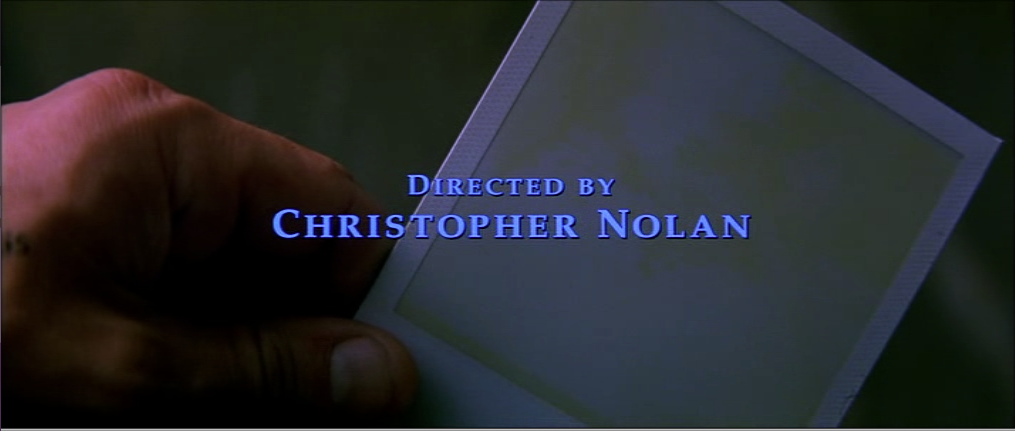
It is now very hard to make out the dead figure in the picture. The fading away process is very slow and it forces the audience to think about the dead person. 'Why are they dead?', 'Are they a bad person?'

We then see the photo being put back into the camera, which is confusing because that is obviously not how a camera works. Still, the director does not reveal the man holding the camera. They want to keep his identity hidden for as long as possible. This is because they want to build the audience's curiosity. Now we can see that the man is taking a picture of the dead person. Why?

The photo then goes back into the camera which gives the audience the sense that the film is being played backwards because photos do not go back into cameras. Still we do not know the identity of the man. Editing is slow and controlled. The audience can be given the impression that the man is either a investigator into the killing or the murderer.

Finally the mans face is shown to the audience and we presume he is the main character. However, his face is dirty and he is breathing heavy which suggests to the audience that there has been a struggle between the two men. The man is still looking intently at the dead body on the floor who has no identity because the audience have not been shown his face, just his remains.

This shot is of the blood on the floor or wall, it is running backwards. This reinforces the fact that the film is being played backwards and that maybe the director is showing the end of the film at the beginning for a reason. The image of blood running on the floor is very violent. Also, it is a close up shot, which might shock the audience and it's quite clear to them now... this film is a thriller.

The editing is now has a faster pace, showing the remains on the scene of the killing. This is a close up of the bullet case which we presume held the bullet that has killed the man laying on the floor. The close up shows it's importance, which reinforces the fact that it is the case of the murderers bullet.

It cuts to a pair of blood splattered glasses that lay on the floor. These may be the murderers or the victims glasses, it isn't made clear. All we know is that there is blood on the wall, the blood of the victim. This wasn't a quiet or quick murder. The murderer has made it very violent which may mean that the victim deserved it.

There is now a close up of the victim. He has a bullet hole in the back of his head. Which can suggest he was shot from behind and may not have expected it, which makes it now seem that the murderer could have shot the victim in cold blood. The image is very graphic and would intregue the audience into wanting to watch further to see in the victim deserved it or not?

The clip is still being played backwards as we see the gun go back to the killers hand, he is still intently staring at the body and looking very calm and collected. He seems to know what he's doing and the audience are now asking why? Why did this man kill the other?

A second close up on the bullet case is show as it moves from the spot it landed. This therefore concludes that the bullet case held the bullet that killed the man who lays on the floor.

There is a close up of the gun on the back of the victims head, ready to fire. The victim has his back to the murderer. It could be that the victim was ready for his death and knew he had done wrong or could it be that he was an innocent man?

The bullet moves back into the gun (as the clip is playing backwards) and theres a extreme close up on the mans hand holding to gun to reinforce that he is the killer. The editing is still fast, which could show the panic and struggle both men faced in the run up to this scene.

There is now a very clear midshot of the man holding the gun in the direction of the victim. Therefore, this finally proves that he is the killer. However, now the audience want to know why he is the killer and what did the victim do to deserve being shot in the back of the head?
This is a very succsessful opening as it allows the audience to become engaged and trigger questions in the first 30 seconds of the film. Therefore, the audience are more likly to watch the whole film because they want to find out what happened to lead up to this very graphic and violent murder.
Thursday, 3 November 2011
Comparison between a film Trailer and Opening Sequence
Trailer - V for Vendetta
A trailer is a promotion of a film. It shows snippits of the main parts of the film to get the audience interested, in the case there is a voice over from the film and we see a girl whom seems to be the main character. Important parts and quotes of the film is shown for example 'they created a monster'. This gets the audience asking questions and asking whos the monster, whos the man in a mask and why is he trying to hurt people. The character of the man in the mask is mysterious and the audience do not know a thing about him, a trailer gets the audience asking questions and if they are interested in a action packed film which is portrayed in the editing then they will go to view it.
Opening Sequence - Kill Bill Volume 2
An opening sequence is the beginning of a film, usually including titles and the names of the director and actors. This particular opening sequence talks about the film before seeing as it's 'Volume 2' the second film in the Kill Bill series. Straight away the audience meet the main character and also hear a mans voice (by this time in the series will still do not know the character Bill properly), it shows the woman on the floor with blood on her face obviously in alot of distress. She is then shot and the sequences goes to black, when it fades back in she is doing an active monolouge in what looks like a car in the future, she talks about what has happened to her. You know exactly who the main character is at this point of the film. You then ask the question about how she managed to servive to tell her story. Simularly to the Trailer the opening sequence will show some main titles of the film such as the director and actors and the makers of the film, they normally use a background that relates to the film.
A trailer is a promotion of a film. It shows snippits of the main parts of the film to get the audience interested, in the case there is a voice over from the film and we see a girl whom seems to be the main character. Important parts and quotes of the film is shown for example 'they created a monster'. This gets the audience asking questions and asking whos the monster, whos the man in a mask and why is he trying to hurt people. The character of the man in the mask is mysterious and the audience do not know a thing about him, a trailer gets the audience asking questions and if they are interested in a action packed film which is portrayed in the editing then they will go to view it.
Opening Sequence - Kill Bill Volume 2
An opening sequence is the beginning of a film, usually including titles and the names of the director and actors. This particular opening sequence talks about the film before seeing as it's 'Volume 2' the second film in the Kill Bill series. Straight away the audience meet the main character and also hear a mans voice (by this time in the series will still do not know the character Bill properly), it shows the woman on the floor with blood on her face obviously in alot of distress. She is then shot and the sequences goes to black, when it fades back in she is doing an active monolouge in what looks like a car in the future, she talks about what has happened to her. You know exactly who the main character is at this point of the film. You then ask the question about how she managed to servive to tell her story. Simularly to the Trailer the opening sequence will show some main titles of the film such as the director and actors and the makers of the film, they normally use a background that relates to the film.
Friday, 28 October 2011
10 Shot Story - Grace Potton, Jamie Watts and Chris Pattwell
Our aim in this task was to indicate the importance of an object; in this case it was a wallet. We had to use different camera shots and angles to make it clear to the audience what Jamie and I were doing with the found wallet and what the result was of our actions. The story is of two friends who find a wallet; they look through the wallet and decide to take the money that is inside. The story follows the two friend’s reactions and how they feel during the story.
Push a Little Button - Recreation
This is an advert recreation, this is my first piece of film work. We learnt how to edit and use the cameras for the first time, these skills were the basic skills we need for the rest of our A Level course.
Thursday, 20 October 2011
Grace Potton, Jamie Watts, Chris Pattwell - Jobsite
This is our jobsite recreation, we used the original advert as a stimulus and used our creativity to adapt the advert to our limited area.
Monday, 10 October 2011
Thursday, 6 October 2011
Donnie Darko Recreation.
The whole classes recreation of a scene of Donnie Darko, we learnt the importance of the director and how the actor relies on the directors instructions during filming.
Thursday, 29 September 2011


Subscribe to:
Posts (Atom)